Does Your Edinburgh Fringe Show Need Captions or Surtitles?
If your non-English show is going to the Edinburgh Fringe Festival, the access and translation question often starts as one simple sentence:
We need English subtitles.
That sentence may be useful on a poster or ticket listing. It is not precise enough for production.
A venue may hear “captions” and think about D/deaf access. A translator may hear “surtitles” and think about prepared live translation. A producer may hear “subtitles” and imagine a video-style file. A stage manager may only care whether someone can cue the text live when the actor skips.
Everyone may be using reasonable words.
They may still be planning different things.
The problem is not whether you call them subtitles, surtitles, or captions.
The problem is building the wrong workflow because the word was never defined.
This article is not another full guide to adding English surtitles to a Fringe show. For the practical setup, read how to add English surtitles to a Fringe show.
This article is about the decision that should happen before setup:
What kind of text are you actually asking for?
The Fringe decision: translation, access, or both?
At the Edinburgh Fringe, a non-English company is usually trying to solve one of three related but different problems.
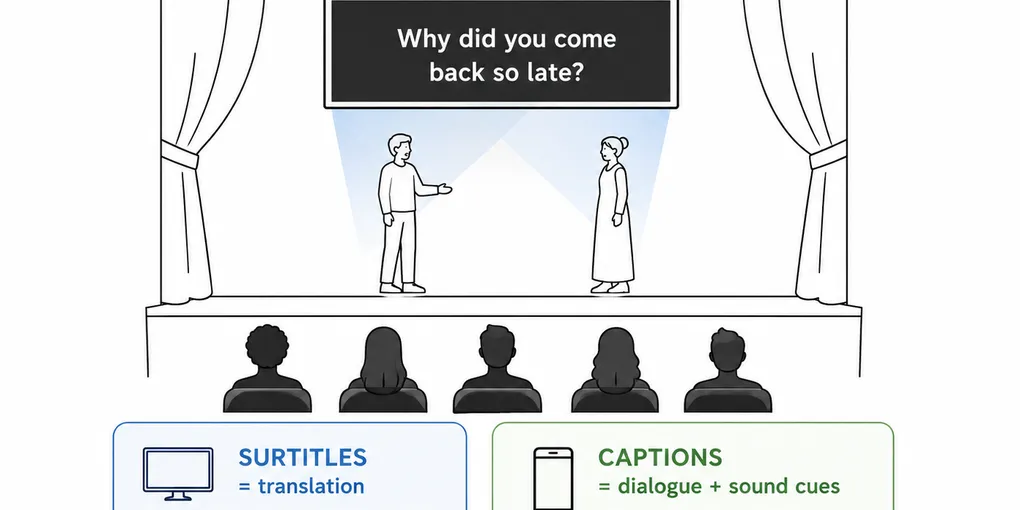
The first problem is translation. The show is performed in one language, and English-speaking audiences need a way to follow it. This is usually an English surtitles workflow.
The second problem is access. D/deaf or hard-of-hearing audiences may need text that represents not only dialogue, but also speaker identification, music, sound effects, or off-stage sound. This is a captioning workflow.
The third problem is delivery. The audience may read the text on a projected screen, in projection mode, on their own phones through a mobile viewer, or through more than one delivery path.
Those decisions are connected, but they are not the same decision.
If the team does not separate them, it can solve the wrong problem. It may prepare translation-only surtitles when the venue is asking about access captions. It may choose a projector before deciding what the text needs to contain. It may tell audiences “subtitles available” while the production team still has no live cueing plan.
The better first question is:
Are we translating language, providing audio access, choosing a delivery method, or doing more than one of those at the same time?
The common terminology traps
The danger is not that one word is morally correct and another is wrong. The danger is that vague language creates vague planning.
| If the team says… | But means… | The risk |
|---|---|---|
| “We need subtitles.” | English translation for a live non-English show | Someone may prepare a video-style file instead of cueable live text. |
| “We need captions.” | English surtitles for foreign-language dialogue | The venue may assume an accessibility captioning requirement with sound cues and speaker information. |
| “We have surtitles.” | Translation-only text | D/deaf or hard-of-hearing access may still be incomplete. |
| “We will project the subtitles.” | A full text workflow | The team may solve screen placement before solving translation, cue timing, or operator recovery. |
| “Audiences can use phones.” | A finished mobile workflow | The team may forget language selection, QR entry, testing, or live cue control. |
| “PowerPoint is fine.” | A live surtitle cockpit | The operator may be trapped when actors skip, pause, or the cue list changes. |
This is the real terminology trap: the word sounds like a decision, but the production still has to define the content, delivery, and live operation.
For the general terminology pillar, read the difference between theatre captions and surtitles.
When English surtitles are probably the right request
For many non-English Fringe shows, the main need is simple: local Edinburgh audiences, reviewers, venue teams, programmers, or touring contacts need to understand the spoken or sung text.
In that case, the production request should usually be:
prepared English surtitles for a live non-English show.
This means the English text is translated and reviewed before the show, then broken into readable live cues. The audience may casually call it “English subtitles,” and that is fine for marketing copy.
Inside the production team, however, “prepared English surtitles” is more useful than “subtitles” because it says three important things:
- the text is a translation, not access captioning by default
- the text is prepared before performance, not typed live from scratch
- the text must work during a live performance, not as a fixed video file
If this is your situation, the detailed setup belongs in the practical guide: how to add English surtitles to a Fringe show.
When captions may be required
Captions do different work.
The Edinburgh Festival Fringe captioning guidance distinguishes captioning from surtitles. In that guidance, surtitles are associated with English translation for foreign-language productions, while captioning can support D/deaf or hard-of-hearing audiences and may include more than dialogue.
That difference matters before tech rehearsal.
A captioning plan may need to answer questions that a translation-only surtitle plan does not:
- Will the text identify speakers?
- Will off-stage voices be labelled?
- Will music, sound effects, or meaningful silence be represented?
- Will a caption user understand who is speaking and what audio information matters?
- Who is reviewing the caption content for access, not only for translation accuracy?
If the show is non-English and also has an access commitment, the answer may be both: English surtitles for translation, plus captioning content where sound and speaker information are required.
Where subtitles still belong
“Subtitles” is still useful audience language.
Many audience members do not search for “surtitles.” They search for English subtitles, subtitles for a non-English play, or subtitles for Fringe Festival shows. If “English subtitles available” is the clearest phrase for a listing, it can be the right public wording.
The risk is using the same broad word as the internal production spec.
Audience-facing copy can say:
English subtitles available.
The internal production note can say:
Prepared English surtitles, reviewed before opening and cued live during performance.
Those two sentences serve different audiences. Keeping both can reduce confusion.
Projection mode and mobile viewer are delivery choices
A screen is not a content strategy.
Projection can be excellent when the room supports it. A shared screen can feel clean and theatrical. Everyone reads the same text. No one needs to hold a phone.
But the Edinburgh Fringe Festival is not one room with one technical setup. A small touring team may face short tech time, awkward sightlines, limited equipment, or a venue that was never designed around surtitles.
That is why mobile viewing can be practical. With a mobile viewer, audience members can open a browser-based view, choose an enabled language, and read the prepared text on their own phones.
But mobile viewing is still only a delivery method. It does not decide whether the text is translation, captioning, or both.
It is not automatically the most accessible choice either. Some people may not have a suitable phone, may find a small screen tiring, or may prefer a shared display. The venue may restrict phone use or have unreliable connectivity. A mobile route should be explained before booking, tested in the room, and paired with a suitable fallback for the audience the production intends to serve.
Before choosing projection, mobile viewer delivery, or both, decide:
- what text content the audience needs
- which languages should be available
- whether captioning information is required
- whether the original language should remain visible for some audiences
- whether the venue has a reliable shared-screen position
- whether front-of-house staff can explain the audience access route
- whether the intended users have tested the proposed reading experience
For the product workflow, see projection and mobile surtitles workflow.
A tech rehearsal checklist for Fringe teams
Before tech rehearsal, a producer or company manager should be able to answer these questions.
Text content
- Are we preparing English surtitles, captions, or both?
- If captions are required, have we included speaker labels, music, sound effects, and off-stage audio where relevant?
- Has the English text been reviewed for readability during live performance?
Delivery
- Will audiences read from projection mode, mobile viewer delivery, or both?
- If using projection, where will the screen or projector output sit?
- If using mobile viewing, how will audiences receive the link or QR code?
- If there are multiple languages, who decides which tracks are enabled?
- Have the phone policy, network conditions, power, and a non-mobile fallback been checked?
Operation
- Who is responsible for cueing the text during performance?
- Is there a blackout or hide-text procedure if the wrong text appears?
- What happens if the show changes after the rehearsal?
- Who confirms the final text before doors open?
- Has the operator rehearsed jump recovery and the fallback display route?
This checklist is deliberately practical. It keeps the terminology discussion from staying abstract.
When SurtitleLive fits
SurtitleLive is designed around prepared live text, not around one fixed screen format.
Once the team knows whether it is preparing translation surtitles, access captions, or both, the setup becomes easier to configure:
- language tracks
- projection mode
- mobile viewer delivery
- operator cueing
- blackout or hide-text behavior
- multi-language audience access
SurtitleLive is a strong fit when the team has a script or mostly stable performance text, can review the text before opening, and needs live delivery rather than a fixed video subtitle file.
If the show is mostly improvised, changes heavily every night, or depends on long audience interaction, the team may need a live captioner, speech-to-text reporter, or hybrid setup.
The point is not to make every Fringe show more technical.
The point is to stop technical decisions from being made by accident.
See how SurtitleLive supports mobile and projected surtitles
A clearer production request
Instead of asking a venue or tool provider:
Can we have subtitles?
Ask something closer to this:
We need prepared English surtitles for a live non-English show. We may need projection mode, mobile viewer access, or both. If captioning access is required, we need to plan sound and speaker information separately.
That request is longer.
It is also much harder to misunderstand.
It tells the venue that the show is live. It tells the translator that the text must be readable during performance. It tells the producer that access captions and translation surtitles are related but not identical.
Most importantly, it keeps the team from discovering the difference only during tech.
The poster can be simple. The workflow cannot.
Use “English subtitles” when that is what audiences understand.
Use “surtitles” when planning prepared live translation.
Use “captions” when planning access text for sound as well as speech.
Use “projection mode” or “mobile viewer” when deciding how the audience will receive the text.
The word does not need to be perfect in every poster.
The workflow does.
Prepare the right Fringe surtitles or captions workflow
Sources
- Edinburgh Festival Fringe, Captioning your show
- SurtitleLive, How to Add English Surtitles to a Non-English Show at the Edinburgh Fringe Festival
- SurtitleLive, Theatre Subtitle Software for Script Prep and Live Delivery
Key Takeaways
- Define whether the production needs language translation, audio access, an audience delivery method, or several of these together.
- English surtitles translate a live non-English performance; accessibility captions may also identify speakers, music, effects, and off-stage sound.
- Projection and mobile viewing are delivery choices, not definitions of what the text contains.
- Public listings can say “English subtitles,” while the internal specification should name content, languages, operator, testing, and fallback.
FAQ
When does a Fringe show need English surtitles?
Use prepared English surtitles when audiences need reviewed translation for a live performance spoken or sung in another language.
When does a Fringe show need accessibility captions?
Captions may be needed when D/deaf or hard-of-hearing audiences require dialogue plus relevant speaker, music, sound-effect, or off-stage information.
Are projection and mobile viewing different kinds of text?
No. They are delivery methods. The production must first decide whether the content is translation, accessibility captioning, or both.
Is mobile viewing automatically the most accessible option?
No. Device access, screen size, venue policy, connectivity, audience preference, front-of-house guidance, and a fallback all matter.
Glossary
- Surtitles: Prepared translation displayed in time with a live performance spoken or sung in another language.
- Accessibility captions: Audience text that may represent speech, speakers, music, sound effects, and off-stage sound.
- Delivery method: The route by which audiences receive text, such as shared projection, a mobile viewer, or both.
- Production specification: The internal definition of text content, languages, display route, operator, review, testing, and fallback.
- Live cueing: The operator's work of triggering and recovering prepared text in time with the performance.