
Each audience member chooses one
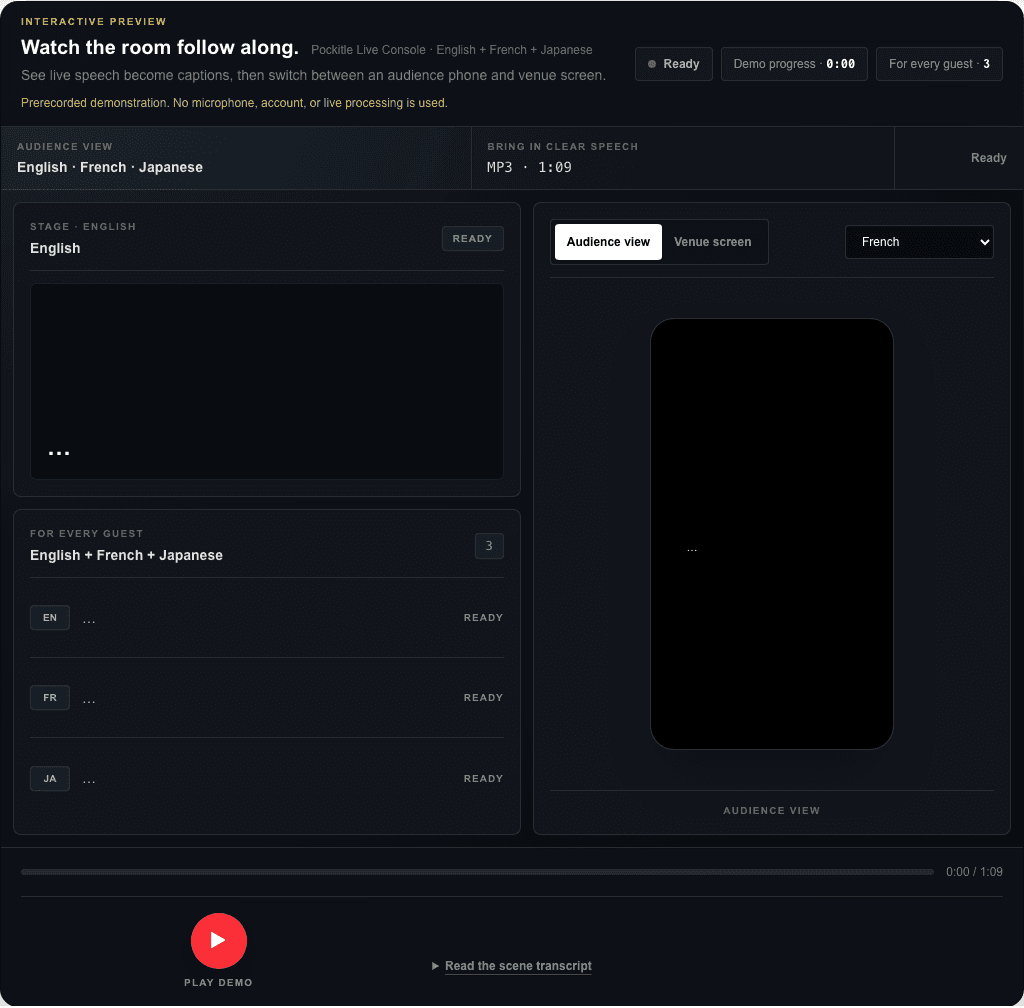
The audience enters through one link, sees the available caption languages, and chooses the one they want to read. Each venue screen is assigned one selected output language.
Pockitle multilingual live captions
Reach more people with Pockitle multilingual live captions: turn one spoken language into original captions and up to three live translations for audience phones and venue screens.
Language model
The event uses one spoken source language. Pockitle creates captions in that original language and can add up to three translated caption outputs. It does not automatically switch source languages when different speakers begin talking.
Language workflow
The audience enters through one link, sees the available caption languages, and chooses the one they want to read. Each venue screen is assigned one selected output language.
Pockitle delivers written captions. It does not create translated speech, replace an interpreter, or turn machine translation into reviewed publication text.
Names, numbers, specialised vocabulary, overlap, and poor sound can produce errors. Test every selected language and tell the audience that captions may be delayed or wrong.
Related planning
Promise only the languages the event can test and support.
Share infrastructure without treating translation and access as identical services.
Set the source, outputs, stage input, duration, and credit boundary.
Every run includes the original-language captions and can add up to three translated caption languages.
No. A Pockitle run uses one fixed spoken source language. Automatic source-language switching and code-switching are outside the current product boundary.
Yes. Each screen is assigned one selected output language.
No. They are machine-generated during the event and can be delayed or wrong. Use prepared, human-reviewed subtitles when the production requires approved wording.