When Important Words Deserve to Reach Everyone
SurtitleLive is now Pockitle Cue.
Some words are only said once.
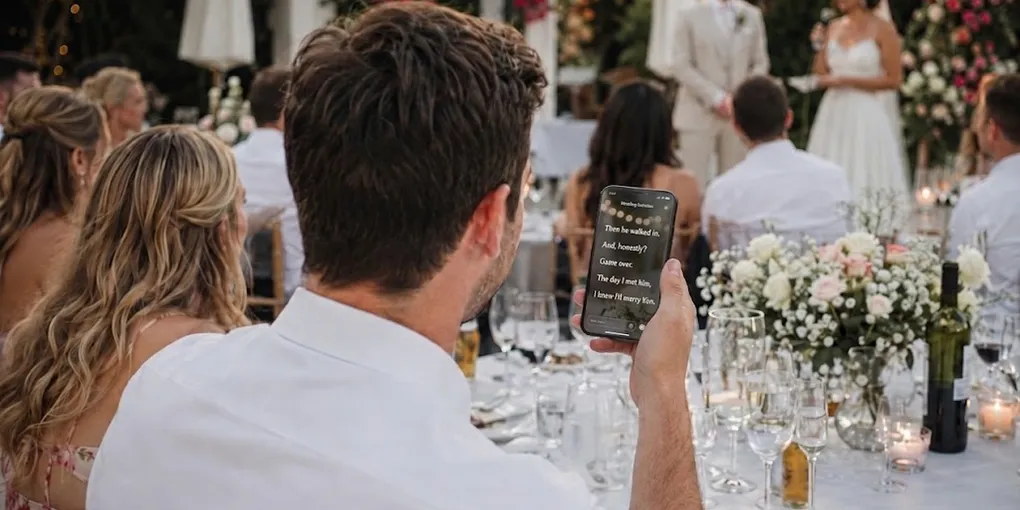
“I do” at a wedding.
A researcher finally presenting work that took ten years to complete.
A student finding the confidence to raise a hand and answer in class.
A father telling a story about his daughter during a wedding speech.
What makes these moments valuable is not simply that someone is speaking.
What matters is whether the people in the room can understand together, laugh together, feel together, and participate together.
In real life, not everyone can follow spoken words with the same ease.
Someone may be sitting too far away.
Someone may hear differently.
Someone may understand the emotion but not be fluent in the language being spoken.
Someone may be attending an academic conference in a second language and know they can understand the ideas, if only the words would slow down by half a second.
Someone in a classroom may be using so much effort just to hear clearly that there is little attention left for thinking about what the teacher actually means.
The real value of captions is often not the moment text appears on a screen.
It is the moment a person who was close to being left out can rejoin what is happening.
A wedding should not only belong to the people who speak the same language
Imagine a wedding.
The groom says his vows in English.
The bride’s grandmother speaks Japanese.
She can see that people are smiling. She can see her granddaughter crying. She knows something important is being said.
But she does not know the sentence that made the whole room go quiet.
Later, she can ask, “What did he say?”
That is not the same as reading the words in the moment.
A wedding is not a document that can always be caught up on later. Some emotions belong to a particular second.
If captions let the grandmother read, at the same moment:
“Whatever happens next, I will stand beside you.”
she has not merely received a translation.
She has participated in the wedding.
That is one of the most meaningful uses of live captions at a wedding.
Not as a technology demonstration.
As a way of keeping more people inside the moment.
The best captions may be the ones people forget about after a few minutes
A good live-caption experience should not require every guest to learn a new tool.
Someone should not have to download an app, create an account, remember a password, and work through several settings just to follow the vows.
The most natural experience is often simpler:
Scan a QR code.
Open the browser.
Choose a language.
Then put your attention back on the people getting married.
Pockitle Live is designed around that kind of audience experience.
People can use the browser on their own phone without installing a dedicated audience app. One event can provide original-language captions and selected translated captions, while a venue screen can show one chosen language for the room.
The technology is present, but it should not become the centre of the event.
At an academic conference, the expensive part is often the feeling that you are always missing something
Many people remember the first time they attended a major international academic conference.
You can read the papers.
You know the field.
Then the speaker walks on stage and everything suddenly becomes faster.
A different accent.
An unfamiliar name.
An acronym.
A technical term.
You are still processing one slide when the speaker has already moved to the next.
You are not incapable of understanding.
You may simply need half a second more.
Live speech does not stop because you need that half second.
That is where captions can provide more than a conventional idea of “accessibility”.
They can provide cognitive support.
Hear a sentence and see it at the same time.
Miss a technical word and recover it from the text.
Listen in a second language without spending all of your mental energy decoding the sound.
Then your attention can return to the question that actually matters:
What is this person’s research saying?
Multilingual captions are not about erasing language differences
The more international an academic event becomes, the more obvious one strange contradiction can feel.
People may have travelled from fifteen countries.
But everyone is still expected to process one spoken language at the same speed.
That is administratively convenient.
It is not always equally easy for the people in the room.
Live translated captions do not replace professional interpreters, and they should not be presented as error-free translation.
But in the right setting, they can lower the threshold for participation.
One delegate might listen to English while reading Japanese.
Another might choose French.
Someone else may only need the original English captions.
Everyone remains in the same session.
Nobody has to wait until the event is over to receive a translated document.
The difference can look small on a feature list.
For the person using it, it can change the experience of the whole room.
Classroom captions may change more than whether someone can “hear”
When people hear the phrase classroom captions, they often think first about deaf or hard-of-hearing students.
That is an important use.
But the number of people who can benefit from another reading route is wider than that.
Imagine an international student.
Their English is good.
They passed the language requirements.
Reading the textbook is not a problem.
But the lecturer speeds up when they become excited.
A student asks a question from the back of the room.
People laugh.
The lecturer gives a brilliant example in response.
The international student understands perhaps seventy percent.
The rest has to be guessed.
After one class, they have still learned something.
They have simply worked much harder than the student sitting next to them.
This is one way classroom captions can help.
They do not need to turn every word a teacher says into a permanent official transcript.
They can function as a second channel in the moment.
Miss something? Read it.
Unsure of a word? Check it.
Need a little longer to process an accent? Let the text help you catch up.
Good classroom captions do not mean students no longer need to listen.
They can make it easier for more students to listen to the ideas, instead of spending the whole lesson trying to decode the sound.
Sometimes the most human feature is choice
Not everyone wants to look at a large screen at the front of the room.
Not everyone wants to hold a phone.
So the most human-centred caption design is often not about deciding one reading method for everybody.
It is about giving people choices.
One person prefers a shared display.
Another wants larger text on a phone.
Someone only glances down when a word is unclear.
Someone needs another language.
Someone does not use the captions at all.
All of them can still remain part of the same event.
That is an important idea behind Pockitle:
captions do not have to become the only way the room experiences the event.
They can be an additional reading route.
The people who need it can use it.
The people who do not may barely notice it is there.
Weddings, classrooms and conferences are asking the same question
These settings look completely different.
A wedding is about relationships and emotion.
A classroom is about learning.
An academic conference is about exchanging knowledge.
But from a human point of view, they ask the same question:
When important words are happening, who can truly keep up?
It is easy to turn “access” into a technical checklist.
Captions: yes.
QR code: yes.
Translation: yes.
Done.
But the more useful questions are different:
- Did the grandmother understand the vow at the moment it was spoken?
- Did the international student miss one technical term and then lose the next ten minutes?
- Did the early-career researcher at an international conference have enough confidence to keep following the discussion and ask the question they came to ask?
- Did the attendee whose hearing is changing have a way to follow without needing to announce their needs to the room?
These questions rarely appear in a software feature table.
They are the reason caption technology matters.
Human-centred design also means being honest about limits
Being human-centred does not mean overpromising.
Machine-generated live captions can be wrong.
Names can be recognised incorrectly.
Specialist terms can fail.
Translations can lose nuance.
Overlapping speech makes recognition harder.
Singing and music-led content are not reliable use cases for the current Pockitle workflow.
Each Pockitle run uses one fixed spoken source language and can add up to three written translations. It does not automatically switch the source language when different speakers begin speaking another language.
It is also not:
- a replacement for professional CART;
- a replacement for simultaneous interpreting;
- an official transcript;
- a legal or educational compliance guarantee.
These limits do not make live captions meaningless.
They make it more important for an organiser to know exactly what they are promising.
If somebody’s medical care, safety, examination result or legal rights depend on every word being exact, the event should use the professional human service and review process appropriate to that responsibility.
But if the question is:
“Can we help more people in this room follow what is being said right now?”
live captions can be deeply useful.
From “providing captions” to inviting more people in
The most interesting future is not one where every event has more screens.
It is one where the technology becomes quieter.
A wedding guest scans a QR code and understands the vows at the same time as everybody else.
A student opens a link and does not fall out of a lecture because one word was missed.
A conference delegate chooses a reading language and can focus on the argument rather than constantly translating the sound in their head.
The captions are not the main character in any of these stories.
People still are.
The technology only opens the door a little wider.
It lets someone who might otherwise have been standing just outside the conversation step back in.
If you are planning a wedding, lecture, academic conference, classroom, community meeting or workshop, you can start with the Pockitle Live overview.
Do not begin with:
“How many caption languages can we turn on?”
Begin with:
“Is there someone in this room who could participate more fully if they had another way to follow the words?”
If the answer is yes, it may be worth trying.
Key Takeaways
- Live captions can help people follow important words together at weddings, conferences, classrooms and community events.
- Audience members open Pockitle captions in a phone browser through a link or QR code; no dedicated audience app is required.
- Each run uses one fixed spoken source language and can add up to three written translation languages.
- Machine-generated captions support participation but do not replace professional CART, simultaneous interpreting or an official transcript.
Frequently Asked Questions
How do guests open Pockitle live captions?
They open an event link or scan its QR code in a phone browser. They do not need to install a dedicated audience app or create an audience account.
Can Pockitle show captions in more than one language?
Yes. One run uses one fixed spoken source language, provides captions in that language, and can add up to three written translation languages.
Can live captions help at weddings, conferences and in classrooms?
They can provide another reading route for guests, delegates and students who hear differently, process accents or technical terms, or prefer to read another language.
Do Pockitle captions replace CART or professional interpreters?
No. Captions and translations are machine-generated and may be delayed, incomplete or wrong. They are not professional CART, simultaneous interpreting, an official transcript or a compliance guarantee.
Glossary
- Live captions: Text generated from speech and displayed while an event is happening.
- Source language: The single fixed spoken language selected for one Pockitle run.
- Written translation: Automatically translated caption text offered in addition to the source-language captions.
- Audience viewer: The browser page that an audience member opens by link or QR code.
- CART: A professional real-time captioning service that Pockitle does not claim to replace.